1. A Landmark Event in Global Sport
The 2026 FIFA World Cup, also known as FIFA World Cup 26, is scheduled from June 11 to July 19, 2026, and will be co-hosted by the United States, Canada, and Mexico—the first tournament jointly hosted by three nations.
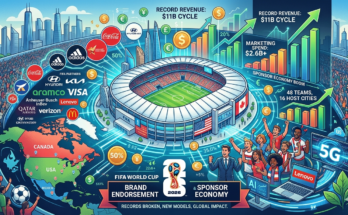
This edition marks the first major expansion in decades, with 48 national teams, an increase from 32, competing across 16 host cities.
2. The Political Arena: More Than Just Football
With former President Donald Trump invoking the spotlight at the World Cup draw event in Washington, D.C., the tournament has already become a stage for wider political posturing and media spectacle.
Amid growing scrutiny from organizations like Human Rights Watch, FIFA is under pressure to ensure civil liberties, particularly in light of immigration crackdowns and protests in U.S. host cities such as Los Angeles.
3. Economic Impact: A Revenue Powerhouse
This tournament is projected to deliver massive economic benefits across the host nations:
- Globally, the event is expected to generate up to USD 40.9 billion in GDP, with USD 8.28 billion in social benefits, and support nearly 824,000 full-time jobs.
- In the U.S. alone, the study estimates over 30.5 billion USD in economic output, 185,000 FTE jobs, and 17.2 billion USD in GDP growth.
- Los Angeles County—a key host—expects a USD 594 million local economic impact, USD 34.9 million in tax revenue, and $243 million in additional wages from visitor spending.
The World Cup’s scale also provides rich marketing opportunities for regional brands to engage fan groups across multiple cities.
4. Equally Grand Challenges: Environmental Concerns
The 2026 World Cup may soon earn the distinction of being the most polluting in history. Emissions are expected to soar, largely driven by extensive air travel across North America:
- Estimated emissions total 9.02 million metric tons of CO₂, surpassing those of the 2010‑2022 tournaments combined.
- Travel accounts for approximately 85% of emissions, with a projected 3.7 million tonnes of CO₂—higher than Qatar 2022’s total footprint—despite efforts at carbon offsetting.
While host states will use existing stadiums, reducing construction emissions, critics argue FIFA’s sustainability strategies lack transparency and rest too heavily on offsets rather than meaningful carbon reductions.
5. Predictions: Champions and Semifinalists
Favorites & Odds
- Spain leads the betting odds (5/1), propelled by a youthful, dynamic squad fresh off a dominant Euro 2024 campaign.
- Brazil (6/1) remains a perennial powerhouse with attack-minded stars and World Cup pedigree.
- France (±7/1) brings depth and track record, but recent semi-final losses to Spain highlight a psychological barrier.
- Argentina, as defending champions, still pose a threat with a solid chance of a repeat.
Expert Outlooks
- CBS Sports ranks Argentina slightly ahead of Spain, England, and France.
- BetMGM includes strong contenders like Portugal and Germany among early favorites.
My Prediction
- Champion: Spain — Building upon their Euro triumph and current squad strength, they seem well-positioned to claim a long-awaited second World Cup title.
- Semifinalists (besides finalists): Brazil, France, Argentina.
6. Final Take
The 2026 FIFA World Cup will stand as a global showcase—not just of soccer, but of politics, economics, and environmental responsibility. Its legacy may be defined not only by the champions crowned but also by how it navigates these complex forces.