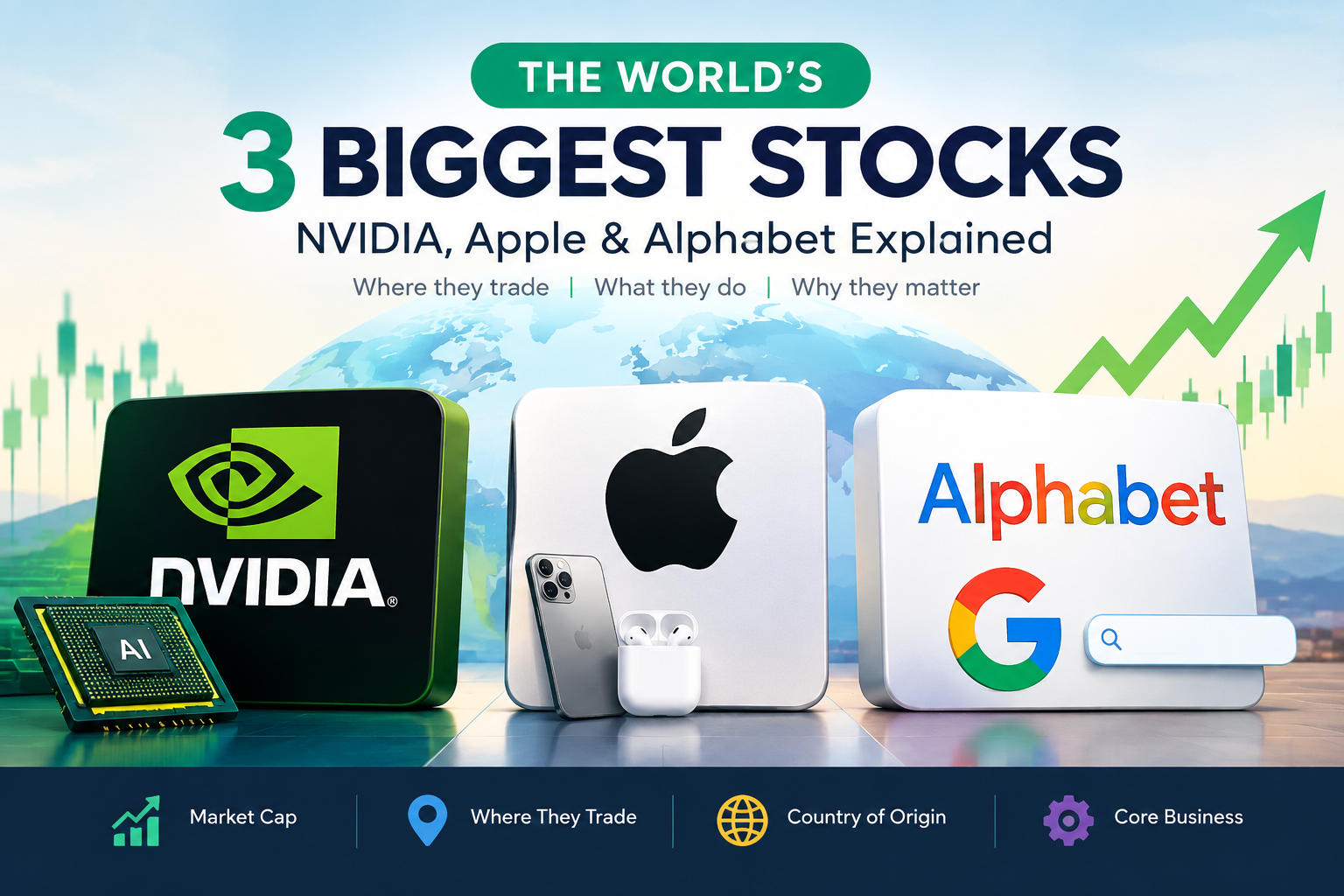
What are the world’s biggest companies, where do their stocks trade, and what makes them so valuable?
The answer changes over time because stock prices change every trading day. However, as of September 2026, three companies stand at the top of the global stock-market rankings by market capitalization:
- NVIDIA (NASDAQ: NVDA)
- Apple (NASDAQ: AAPL)
- Alphabet (NASDAQ: GOOGL)
Quick Comparison: The Big 3
| Company | Ticker Symbol | Country of Origin | Primary Exchange | Market Cap (Valuation) | Core Revenue Driver |
| Nvidia | NVDA | United States | NASDAQ (USA) | ~$5.1 Trillion | AI hardware, GPUs, data center chips |
| Apple | AAPL | United States | NASDAQ (USA) | ~$4.8 Trillion | iPhones, hardware ecosystem, digital services |
| Alphabet (Google) | GOOGL / GOOG | United States | NASDAQ (USA) | ~$4.1 Trillion | Search ads, YouTube, Cloud infrastructure |
Together, these companies represent a fascinating picture of the modern economy. NVIDIA is deeply connected to artificial intelligence and computing infrastructure. Apple built one of the world’s most valuable consumer technology ecosystems. Meanwhile, Alphabet operates Google, one of the most important internet and advertising businesses in history.
For a new investor, studying these companies can be useful—not because the largest company is automatically the best investment, but because they provide a simple introduction to business models, revenue, profits, market capitalization, technology, and competitive advantages.
What Does “Biggest Stock” Actually Mean?
Before looking at the three companies, let’s clarify one important term.
When people call a company the “biggest” in the stock market, they usually mean market capitalization, or market cap.
The calculation is simple:
Market Capitalization = Share Price × Number of Outstanding Shares
For example, if a company has 10 billion shares and each share is worth $100:
10 billion × $100 = $1 trillion market capitalization
Therefore, market capitalization tells us how much the stock market currently values all of a company’s outstanding shares.
It does not mean the company has $1 trillion sitting in its bank account.
It also does not necessarily mean the company has the highest revenue or the highest profit.
That distinction is important for new investors.
1. NVIDIA — The Company Behind the AI Computing Revolution
Headquarters: Santa Clara, California, USA
Main business: Semiconductors, GPUs, AI computing and data-center infrastructure
NVIDIA is currently the world’s largest publicly traded company by market capitalization, with a September 2026 market value of roughly $5.4 trillion.
But what does NVIDIA actually sell?
Many people know NVIDIA because of the small green logo found on gaming computers. Even I used to know this company as a gaming software company before it came into the limelight for its AI chips. However, the company’s business has expanded far beyond gaming.
NVIDIA develops graphics processing units (GPUs) and related computing platforms used for:
- Artificial intelligence
- Data centers
- Machine learning
- Scientific computing
- Gaming
- Professional visualization
- Automotive applications
NVIDIA describes itself as a pioneer of GPU-accelerated computing and identifies gaming, professional visualization, data centers and automotive as major markets.
Why are NVIDIA chips so important?
Traditional computer processors are excellent at performing many sequential tasks.
GPUs, however, are particularly powerful at performing large numbers of calculations simultaneously.
That makes them extremely useful for modern AI systems.
Training and running advanced AI models requires enormous amounts of computing power. As companies and governments build AI infrastructure, demand for high-performance computing has become a major driver of NVIDIA’s business.
In other words:
AI growth → more computing demand → more demand for GPUs and AI infrastructure.
This is one of the central stories behind NVIDIA’s enormous market capitalization.
NVIDIA is more than a chip company
Another important lesson for beginners is that NVIDIA’s business is not simply about selling individual chips. The company has developed a broader ecosystem around its hardware, software and computing platforms. That ecosystem can make it more difficult for customers to switch technologies quickly.
For investors, this raises an interesting concept:
Competitive advantage
A company becomes particularly powerful when customers have strong reasons to continue using its products. NVIDIA’s combination of hardware, software, and developer ecosystem is an important part of its competitive position.
However, investors should also remember that a strong business can still be an expensive stock.
A great company and a good investment are not always the same thing.
2. Apple — From the iPhone to an Entire Technology Ecosystem
Headquarters: Cupertino, California, USA
Main business: Consumer electronics, software, and digital services
Apple is one of the most recognizable companies in the world.
As of September 2026, Apple ranks second globally by market capitalization, at roughly $4.7 trillion.
Apple’s shares trade on the NASDAQ Stock Market under the ticker AAPL.
But Apple’s business is much bigger than the iPhone.
Its major products and services include:
- iPhone
- Mac
- iPad
- Apple Watch
- AirPods
- Apple Vision Pro
- App Store
- Apple Music
- Apple Pay
- iCloud
- Apple TV and other services
Apple reported $109.4 billion in revenue in its fiscal 2026 third quarter, with iPhone, Mac, and Services all recording June-quarter revenue records.
The Apple Business Model
Apple’s greatest strength is arguably its ecosystem.
Imagine someone buys an iPhone.
That person may then purchase:
- AirPods
- Apple Watch
- MacBook
- iCloud storage
- Apple Music
- Apple TV+
- Apps through the App Store
Each product can therefore reinforce the value of the others.
This creates a powerful business model:
Hardware → Users → Ecosystem → Services → Recurring revenue
Services are particularly interesting for investors because they can generate revenue beyond the initial hardware purchase.
Apple’s fiscal 2026 financial statements show substantial revenue from both products and services, illustrating how the company has developed multiple sources of income.
Why is Apple so valuable?
Apple combines several powerful assets:
Brand + technology + ecosystem + customer loyalty + global distribution
The company also generates enormous amounts of cash.
For investors, Apple provides an interesting example of how a company can evolve from primarily selling physical products into a broader technology and services ecosystem.
3. Alphabet — The Company Behind Google
Headquarters: Mountain View, California, USA
Main business: Internet services, digital advertising, cloud computing, and AI
The third company in our list is Alphabet Inc., the parent company of Google.
As of September 2026, Alphabet’s market capitalization is approximately $4.1 trillion.
Alphabet’s publicly traded shares include:
- GOOGL — Class A shares
- GOOG — Class C shares
Both trade on NASDAQ.
What does Alphabet actually do?
When most people hear Alphabet, they immediately think about Google.
And for good reason.
Google operates some of the world’s most widely used digital products and services, including:
- Google Search
- YouTube
- Android
- Google Maps
- Google Chrome
- Google Play
- Google Cloud
- Google Workspace
- Google Ads
The company’s fundamental business model has historically been strongly connected to digital advertising.
Think about what happens when someone searches Google for:
“Best laptop for business”
Businesses can pay to appear prominently when potential customers search for relevant products or services.
This creates a simple economic relationship:
Users → Search activity → Advertisers → Advertising revenue
Google Cloud and the AI Opportunity
Alphabet is no longer simply an advertising company.
Google Cloud has become another important part of its business.
Cloud customers pay for computing power, storage, software and other infrastructure.
At the same time, Alphabet is investing heavily in artificial intelligence.
Google has its own AI technologies, data centers, specialized computing hardware and AI products.
This gives Alphabet another major connection to the AI economy—although its business model is considerably broader than NVIDIA’s.
Why Are All Three Technology Companies?
There is a bigger story here.
The world’s largest publicly traded companies have increasingly come from technology and technology-related industries.
Why?
Because technology businesses can potentially scale globally.
A software platform can serve millions or billions of users without requiring a completely new physical store for every customer.
Similarly, digital advertising can reach customers around the world.
And AI infrastructure can become foundational technology for thousands of businesses.
This scalability is one reason investors have placed enormous valuations on technology companies.
But Are the World’s Biggest Stocks Automatically Safe?
No.
This is an important lesson for new investors.
A company can be enormous and still experience a significant decline in its stock price.
For example, its valuation could fall because:
- Earnings disappoint investors
- Growth slows
- Competition increases
- New technology disrupts its business
- Regulation changes
- Interest rates rise
- Investors decide the stock has become too expensive
Therefore:
Large company ≠ risk-free investment
And:
Famous company ≠ automatically a good investment at every price
What Should a Beginner Learn From These Three Companies?
Instead of simply asking:
“Should I buy NVIDIA?”
or
“Should I buy Apple?”
a beginner can ask better questions.
1. How does the company make money?
Understand the business before looking at the stock chart.
2. What drives revenue?
Is revenue coming from advertising, hardware, subscriptions, cloud computing or something else?
3. Is the company profitable?
Revenue alone does not tell the whole story.
4. Does the company generate cash?
Strong cash generation can provide financial flexibility.
5. What is the competitive advantage?
Ask why customers choose this company instead of its competitors.
6. Is the stock expensive?
A wonderful business can still have a valuation that leaves little room for disappointment.
7. What could go wrong?
Every investment has risks.
A Simple Way to Study a Stock
If you are completely new to investing, don’t begin with complicated technical indicators.
Start with the company’s annual report.
Then try to answer five simple questions:
1. What does the company sell?
2. Who pays it?
3. How does it make money?
4. Is revenue growing?
5. Is profit and cash flow growing?
Once you understand these, you can move on to more advanced measures such as:
- P/E ratio
- EPS
- Free cash flow
- ROE
- Debt-to-equity
- Operating margin
- Price-to-sales
- Dividend yield
The Bigger Picture
NVIDIA, Apple and Alphabet represent three different versions of modern technology.
NVIDIA provides much of the computing infrastructure behind the AI revolution.
Apple connects hardware, software and services into a global consumer ecosystem.
Alphabet connects billions of people to information while monetizing digital attention through advertising and expanding into cloud and AI.
Studying these companies is therefore not simply about studying three stocks.
It is about understanding three major economic forces:
Computing.
Consumer technology.
Digital information.
Final Thoughts
For a new stock investor, the world’s largest companies can be fascinating places to start learning.
NVIDIA, Apple and Alphabet didn’t become trillion-dollar companies simply because their stock prices went up. Their valuations reflect enormous businesses, global customers, powerful brands, technology platforms, profits, cash generation and expectations about their future.
However, market capitalization is only the beginning of stock analysis.
The real question is not:
“How big is this company?”
Instead, ask:
“How does this company create value, how does it make money, and what might determine its future?”
That is where stock investing becomes much more interesting.
And once you learn to look at companies this way, the stock market starts to look less like a collection of ticker symbols—and more like a collection of real businesses.
Quick Investor Glossary
Stock: A unit of ownership in a company.
Market Capitalization: The total market value of a company’s outstanding shares.
Revenue: Money a company earns from selling its products or services.
Profit: Money remaining after expenses are deducted from revenue.
Earnings Per Share (EPS): A company’s profit allocated to each outstanding share.
P/E Ratio: A valuation measure comparing a company’s share price with its earnings per share.
Dividend: A portion of a company’s profits distributed to shareholders.
NASDAQ: A major U.S. stock exchange where many technology companies are listed.