The Biggest Commercial Moment in Sports History Is Already Here
The FIFA World Cup 2026 is not just a football tournament. It is the most commercially powerful sporting event ever staged — 48 teams, 104 matches, 16 host cities across the United States, Canada, and Mexico, and an estimated $8.9 billion in total FIFA revenue before the final whistle blows.
Global brands have already locked in their positions. Adidas, Coca-Cola, Visa, McDonald’s, and Bank of America have collectively committed hundreds of millions of dollars. Every Tier 2 sponsorship slot — priced between $65 million and $95 million — is sold out.
But here is what most small business owners miss: the World Cup does not belong to the big brands. It belongs to the streets, the restaurants, the cafés, the local sports stores, and the neighbourhood bars where billions of fans actually experience the tournament.
You do not need a FIFA partnership or a seven-figure ad budget to win this moment. You need a smart, focused strategy — and you need to start executing it now.
Why World Cup 2026 Is Different for Small Businesses
Before we get into tactics, it helps to understand what makes this World Cup uniquely valuable for local and small businesses.
1. Scale, unlike anything before it
Qatar 2022 attracted five billion fans worldwide. The 2026 edition expands the format significantly, with 48 teams instead of 32 and matches spread across three nations. Boston Consulting Group projects a $5–6 billion incremental GDP boost across the three host nations alone. That economic activity does not all flow to stadiums — it flows into every restaurant, retail shop, hotel, and local service business in host corridors and beyond.
2. North America is an untapped market
For the first time in decades, the World Cup lands in the largest underserved football market on the planet. Soccer fandom in the United States has been quietly building for years. This tournament is expected to accelerate that adoption permanently, which means small businesses that connect with fans now are building customer relationships that last well beyond July 2026.
3. The matches run across time zones that work for business
Unlike tournaments in Asia or the Middle East, North American time zones mean evening and weekend kickoffs — exactly when restaurants are full, retail is open, and consumers are actively spending. This is not background noise. It is prime time.
4. The tournament is long
The World Cup runs from June 11 to July 19, 2026. That is over five weeks of sustained consumer attention and spending — far longer than a Super Bowl weekend or a playoff series. Businesses that build momentum early will compound it throughout the tournament.
Lesson 1: Learn from the Big Brands — Then Do It Differently
The large sponsors are not just buying logo placement. They are buying into specific human behaviours. Understanding their playbook helps you borrow the strategy without the budget.
Coca-Cola has partnered with FIFA for nearly five decades because it is embedded in the act of watching football — the drink in your hand during the match. The behaviour it is buying is communal viewing.
McDonald’s has been with FIFA since 1994. Its strategy is built around habitual consumption — the food you eat before, during, and after watching. It is not selling burgers during commercials; it is attaching its brand to match-day rituals.
Frito-Lay and AB InBev (makers of Michelob Ultra, Budweiser, and Stella Artois) are built on the same principle: snacking and drinking while watching sports are powerful, recurring behaviours.
The lesson for small businesses: You do not need to sponsor FIFA. You need to attach your brand to the same behaviours — watching, gathering, eating, drinking, and celebrating. The big brands pay hundreds of millions to access those moments at scale. You can access them locally for almost nothing.
Lesson 2: Own a Ritual, Not Just a Promotion
One of the most common mistakes small businesses make during major events is treating them as a one-off promotional spike — a banner, a discount, a social post. That approach is forgettable.
The smarter play is to build a repeatable ritual that runs throughout the entire five-week tournament.
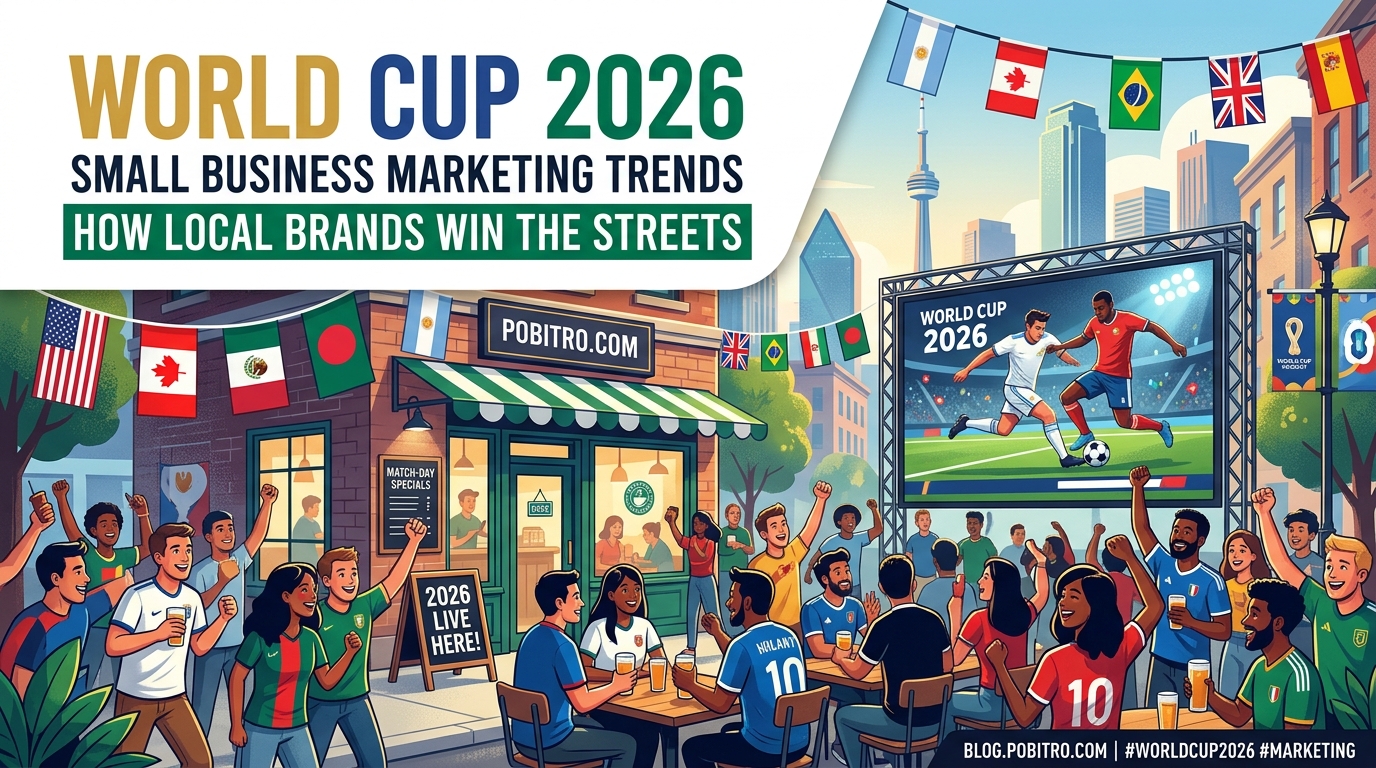
A café that runs a “Match Morning Special” on match days has become part of how local fans start their game day. A restaurant that puts up a prediction board every week becomes a destination. A local sports shop that runs a weekly “Kit of the Match” feature on Instagram becomes the authority on World Cup fashion in its area.
Think about it this way: the final match is July 19. Your promotion should not die on July 20. Plan from the start to convert tournament traffic into returning customers.
Practical ritual ideas by business type:
- Restaurant or café: Daily match-day specials, themed menus per nation playing, live screening events, prediction competitions with prizes
- Retail or fashion: Weekly spotlight on national team kits and football-inspired clothing, match-day styling tips, in-store display themed around the day’s fixtures
- Fitness or wellness: Football-inspired workout classes, team-themed challenges, training content tied to match results
- Professional services (accountant, solicitor, consultant): Weekly match prediction content on LinkedIn, industry-specific posts tied to tournament themes (e.g. “5 Business Lessons from the World Cup Quarter-Finals”)
- Food and beverage delivery: Bundle deals for match-day viewing parties, targeted promotions during kick-off windows
Lesson 3: Segment Your Audience — Do Not Shout at Everyone
The World Cup attracts the broadest imaginable audience — hardcore football fans, casual viewers who tune in for big matches, families, expatriate communities following their home nations, corporate hospitality buyers, and tourists travelling to host cities.
You cannot speak to all of them at once. Narrow your angle.
Ask yourself: which segment is most natural for my business to serve?
- Expat and diaspora communities are among the most engaged fans and will go out of their way to find businesses that acknowledge their national teams. A Bangladeshi restaurant putting up a Brazil or Argentina fan zone — where many Bangladeshis have strong football loyalties — is not just doing marketing. It is creating belonging.
- Families with children are a huge underserved segment during major tournaments. Family-friendly viewing events, kids’ match-day activities, and family meal deals are low-cost, high-goodwill activations.
- Corporate clients are spending on hospitality during the tournament. If your business serves other businesses, the World Cup gives you a genuine reason to offer client entertainment packages, whether that is a match-screening lunch or a tournament-themed gift hamper.
- Tourists and visiting fans in host cities need restaurants, accommodation, local experiences, and services. Visibility on Google Maps, multilingual welcome signage, and targeted ads reaching recent arrivals can capture this audience efficiently.
The 70/20/10 rule for channel allocation: Put 70% of your effort into your strongest existing channel — email list, local Facebook group, Instagram, or in-store activity. Allocate 20% to a secondary channel you want to grow. Use the remaining 10% to experiment with something new, whether that is TikTok match-day clips, WhatsApp group broadcasts, or short-form video content.
Lesson 4: Use the Ambush Playbook Legally and Creatively
Nike is not an official FIFA sponsor. Adidas is. Yet at multiple World Cups — including Brazil 2014 — Nike’s campaigns starring Ronaldo, Neymar, and other athletes generated more social media engagement than the official sponsor’s activity. Nike’s strategy: own the players, own the culture, and never once mention FIFA by name.
Small businesses can apply the same logic.
You do not need official FIFA rights to:
- Run football-themed promotions and events
- Create content around match results, fan culture, and tournament storylines
- Partner with local football clubs, coaches, or amateur players for content
- Host viewing events (subject to appropriate broadcast licensing in your territory)
- Build campaigns around the universal emotions of the tournament — passion, national pride, community, celebration
You cannot legally use: FIFA logos, the official World Cup emblem, the trophy image, the mascot, the word “FIFA,” or official team crests without authorisation. Violating these rules is not worth the risk — creative workarounds are almost always more effective anyway.
The cultural play is always available. Celebrate the football. Celebrate the fans. Celebrate the nations. That is where the emotion lives, and that is where your brand can authentically connect.
Lesson 5: Digital Tactics That Work Without a Big Budget
Google Business Profile — Update It Now
If you are in or near a host city, update your Google Business Profile with World Cup-relevant hours, services, and photos. Tourists and visiting fans search locally on mobile. Being visible and accurate in local search is free and often overlooked.
Social Media: Short Video Is Your Best Tool
Match-day reactions, predictions, behind-the-scenes of your fan zone, staff picks for the tournament, quick recipe clips for match-day snacks — all of this is shareable, costs almost nothing to produce, and rides the wave of organic football conversation.
Post consistently across the tournament, not just at the start. Many businesses put up one World Cup post and then go quiet. The brands that win on social are the ones that show up every match week.
Email Marketing: Segment and Target
Do not blast your entire list with World Cup content if half of them have never shown interest in sports. Create a World Cup segment — people who have engaged with sports-related content, bought football merchandise, or opted in to event-related communications. Send them tailored content. Send your non-football audience their regular content. Respecting the distinction improves both open rates and brand trust.
WhatsApp and Community Platforms
Lay’s, as one of FIFA’s official sponsors, built a WhatsApp-based watch-party experience to feel “social, conversational, and personal” at global scale. You can do the same thing at local scale with almost no budget. A WhatsApp group for your regulars with match-day updates, specials, and predictions costs nothing and creates genuine community.
Lesson 6: Think Beyond the Tournament
The worst outcome from a World Cup campaign is a five-week traffic spike that disappears on July 20 with no lasting business impact.
The best outcome is a five-week campaign that introduces new customers, captures their details, and converts them into regulars.
Plan your post-tournament follow-up before the tournament starts:
- Collect email addresses during event activations
- Offer a “see you again” incentive — a discount, a loyalty stamp, an exclusive post-tournament offer — to everyone who engaged during the tournament
- Tell your brand story: what did your business do during the World Cup? That content has a long shelf life and builds your local reputation
The big sponsors — Hyundai-Kia and Qatar Airways, both renewed their FIFA partnerships through 2030 — are not buying one tournament. They are buying years of sustained association with football. Your equivalent is converting the footfall of one tournament into relationships that outlast it.
Quick-Start Action Plan
Here is a practical timeline for businesses that want to activate smartly:
Right now (planning phase):
- Define your target audience segment and your primary channel
- Update your Google Business Profile and social bios with World Cup context
- Plan your “ritual” — the repeatable activity you will run across the tournament
Two weeks before kick-off (June 11):
- Launch teaser content across your channels
- Finalise any event logistics — viewing screens, seating, themed menus
- Prepare your email segment and draft your first match-week communication
During the tournament (June 11 – July 19):
- Execute consistently — show up every match week, not just the opening fixtures
- Capture customer data (email sign-ups, loyalty programme enrolment)
- Document your activation with photos and video for future content
After the final (July 19 onwards):
- Send your “thanks for joining us” follow-up communication
- Analyse what worked: which content got the most engagement, which promotions drove the most footfall
- Plan how to apply those lessons to the next major event
Final Thought: The Real Lesson from the Sponsor Economy
FIFA’s entire commercial structure — from the $65–$95 million Tier 2 deals to the regional host city supporters — is built on one fundamental truth: people are most receptive to brands when they are emotionally engaged with something they love.
World Cup fans are the most emotionally engaged sports audience on the planet. They are gathered. They are paying attention. They are spending.
You do not need FIFA’s permission or a global budget to be part of that moment. You need to be present, consistent, and genuinely connected to what your local community cares about.
The tournament lasts five weeks. The relationships you build during it can last much longer.